What Should the Internal Temp of Beef Brisket Be?
Many BBQ enthusiasts know the struggle of perfectly cooking beef brisket. It can be tricky to get that tender, flavorful result without overcooking or undercooking. You’re not alone—finding the right internal temperature is a key part of the process.
You should aim for an internal temperature of 195°F to 205°F when cooking beef brisket. This range guarantees collagen breaks down, making the meat tender and flavorful. Use a meat thermometer to check the temperature in the thickest part, avoiding fat or bone.
Monitoring key milestones helps prevent over or undercooking.
Keep in mind, proper technique and patience matter—stick around to find out how to get it just right.
Key Takeaways
- The ideal internal temperature for beef brisket is between 195°F and 205°F.
- Monitoring this range helps ensure the collagen breaks down, making the meat tender.
- Use a meat thermometer and insert it into the thickest part of the brisket.
- Be sure to avoid the fat cap or bone, which can give you a false reading.
- Temperatures below 195°F might make your brisket tough.
- If it goes above 205°F, it can start to dry out.
- The meat is ready when it probes easily within this temperature range.
What Is the Ideal Internal Temperature Range for Beef Brisket?
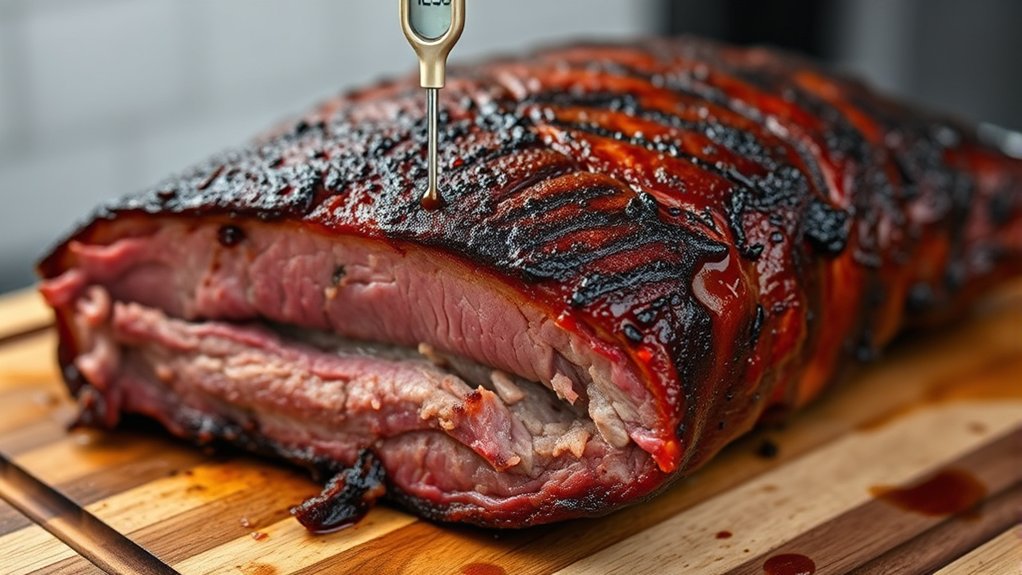
Understanding the ideal internal temperature range is key to perfectly cooked beef brisket. You want to aim for an internal temperature between 195°F and 205°F.
This range ensures the connective tissues break down properly, making the meat tender and juicy. If you cook it below 195°F, the brisket might turn out tough and chewy.
On the flip side, going above 205°F can cause the meat to dry out or become overly soft. Keep in mind, the temperature will rise slightly during resting.
How to Use a Meat Thermometer to Check Brisket Temperature
To get an accurate reading, you need to place your meat thermometer properly into the brisket, avoiding fat or bone.
Watch for the temperature indicators that show when your meat reaches the right internal temperature.
Correct placement and understanding these signals guarantee perfectly cooked brisket every time.
Proper Thermometer Placement
When checking the temperature of your brisket, proper thermometer placement is key to getting an accurate reading. Insert the probe into the thickest part of the meat, avoiding fat pockets and the fat cap, which can give false readings. Make sure the tip is centered and deep enough—at least a couple of inches—to reach the internal muscle tissue.
Keep the thermometer steady and perpendicular to the surface to prevent false readings caused by angled insertion. If you’re using a probe thermometer with a cord, verify the wire isn’t touching the pan or grill grates.
Consistent placement helps track your brisket’s true internal temperature, guaranteeing you cook it to perfection without guessing. Proper placement prevents under or overcooking, giving you confidence in your results.
Recognizing Temperature Indicators
As you keep an eye on your brisket’s internal temperature, it’s important to spot the key signs that show different stages of doneness. When the thermometer hits around 150°F, the meat starts breaking down, and you’ll notice it’s becoming more moist and tender.
At about 160°F, the brisket may feel more bendable, which means it’s nearing the stall—where the temperature tends to stay steady. Once it reaches 190 to 203°F, the meat should be tender enough to probe easily, indicating it’s ready to come off.
Watch how the temperature climbs steadily; a plateau usually means the stall. Recognizing these signs helps you decide when to wrap or rest your brisket so it stays perfect and doesn’t overcook.
Key Temperature Milestones During Brisket Cooking
Understanding the key temperature milestones during brisket cooking helps you gauge progress and achieve the desired tenderness. First, at around 150°F (65°C), the meat starts to break down, but it’s not yet tender.
As you approach 160-170°F (71-77°C), collagen begins converting to gelatin, making the meat more moist. The critical point comes between 190-205°F (88-96°C), where collagen dissolves fully, resulting in tender, pull-apart meat.
During this phase, you might notice the meat feeling soft and yielding to gentle pressure. It’s important to monitor these milestones to prevent overcooking. Once you reach these key temperatures, you can start considering resting your brisket.
Resting helps the juices redistribute and improves tenderness. These milestones serve as your guide to perfectly cooked, flavorful brisket.
What Happens at Different Temperatures in Brisket?
Different temperatures trigger specific changes in brisket’s structure and moisture content. As you cook, around 150°F, the collagen starts to break down into gelatin, making the meat a bit more tender.
Between 160°F and 170°F, the muscle fibers tighten up, which can make the brisket firmer if you’re not careful. When you reach 180°F to 195°F, collagen fully transforms into gelatin, giving the meat a melt-in-your-mouth feel.
Beyond 200°F, the meat keeps tenderizing but there’s a chance it could dry out if you’re not keeping an eye on moisture and humidity. Each of these stages affects how juicy, tender, and flavorful your brisket turns out.
Knowing what happens at these key points helps you control the process for perfect results.
How Resting Affects Brisket’s Final Temperature and Texture
Resting your brisket after cooking helps the temperature settle and the juices to redistribute, which really affects its final texture. As the meat rests, residual heat keeps gently raising the internal temperature by a few degrees, making sure it hits that perfect level of doneness.
This resting process also helps break down collagen, so the meat becomes more tender. If you skip resting, the juices stay trapped inside and tend to spill out when you slice, making the brisket dry.
Allowing it to rest for 15 to 30 minutes lets moisture spread evenly throughout the meat. The result? A juicier, more flavorful brisket that stays warm longer and develops that melt-in-your-mouth tenderness everyone loves.
Common Mistakes When Measuring Brisket Temperature and How to Avoid Them
Are you accurately measuring your brisket’s internal temperature? One common mistake is sticking the thermometer into the thickest part of the meat without avoiding the fat cap or gristle, which can give a false reading. Make sure to probe deep into the center for an accurate measurement.
Another error is using a dirty or faulty thermometer. Always calibrate your device and keep it clean to ensure correct readings. Rushing to check too early can also lead to inaccurate results, so be patient and wait until the brisket has cooked the recommended time.
Also, avoid repeatedly removing the meat to check the temperature. This releases heat and can extend the cooking process. To get reliable results, insert the thermometer properly, calibrate regularly, and wait patiently for the right internal temperature.
Frequently Asked Questions
Can I Cook Brisket to a Lower or Higher Temperature Safely?
Yes, you can cook brisket to a lower or higher temperature safely, but it depends on your desired tenderness and texture. Cooking it to a lower temperature might make the meat tougher, while higher temps can make it more tender.
Always use a reliable meat thermometer to check the internal temperature. Cook it slowly at low heat to ensure safety and get the best flavor.
Just be careful not to go too high or too low, as that can lead to food safety issues.
How Does Altitude Affect Brisket Cooking Temperature?
Altitude affects your brisket’s boiling point, so you might need to tweak your cooking temperature.
At higher elevations, water boils at lower temperatures, which means you’ll want to increase your heat to reach the right internal temperature.
This way, your brisket stays tender, flavorful, and cooked all the way through.
Keep an eye on your thermometer, adjust your methods, and conquer those mountain moisture mysteries for perfect meat every time.
Is There a Difference in Temperature When Using a Wireless Thermometer?
Yes, there can be a difference in temperature readings when using a wireless thermometer. Wireless devices sometimes experience minor fluctuations due to signal interference or calibration issues.
To guarantee accuracy, place the probe correctly in the thickest part of the brisket and verify the device’s calibration regularly. Using a reliable, well-maintained wireless thermometer helps you monitor the internal temperature precisely, resulting in perfectly cooked brisket every time.
Should I Measure Temperature in Multiple Spots on the Brisket?
You should measure the temperature in multiple spots on the brisket to guarantee even cooking. Studies show that meat can vary by up to 10 degrees across different areas.
By checking several points, you prevent undercooking or overcooking, especially since the thickest part determines readiness. Use a reliable probe thermometer and insert it deep into various sections.
Wait for consistent readings to achieve a perfectly cooked, tender brisket. This simple step helps ensure your brisket is cooked evenly and comes out just right.
How Do Different Cooking Methods Impact Ideal Internal Temperature?
Different cooking methods influence the ideal internal temperature of beef brisket. For example, smoking requires maintaining around 195-205°F to break down collagen and make it tender.
Oven roasting may vary slightly, but you generally aim for the same range. Slow cooking can reach lower temperatures for longer, ensuring tenderness without overcooking.
Always monitor internal temperature closely, no matter which method you use, to achieve the perfect, juicy brisket.
Conclusion
Now that you know the perfect internal temp for brisket, you’re well on your way to barbecue mastery! Nail that temperature, rest it properly, and you’ll be serving up slices of juicy, tender meat every time.
Forget about dry, tough meat—your brisket will be so tender, it practically melts in your mouth like butter on a hot skillet. Keep your thermometer handy to hit that ideal temp.
Remember, for a juicy, flavorful brisket, aim for an internal temp of about 195°F to 203°F. This range ensures your brisket is perfectly cooked and tender.
Get your thermometer ready and prepare to impress. Your friends will be amazed at your grilling greatness thanks to your perfect brisket temp!